 ASTROSHOW - AZcendant Observatory
Meteor Movies
HandyAvi was used to capture
the images. HandyAvi's meteor dectection and capture mode does a
good job of recognizing and capturing meteor trails so that the videos
produced are small and contain only meteor trails. (And,
unfortunately, airplane trails. HandyAvi provides editing tools that
lets you select frames that you want to keep and discard any airplane
trails...)
Movies were created using HandyAvi in its Meteor Trail Images Capture
mode. Camera was Watec Ultimate with .0001 lux sensitivity.
Click on an image below to see the full-size movie...
 Geminids - 13/14 Dec 2010 From back yard of my home in Tempe, AZ. EXCERPT (2.5 Megabyte .wmv file.) |
Geminids - 13/14 Dec 2010 From back yard of my home in Tempe, AZ. THE WHOLE THING (20.4 Megabyte .wmv file.) I also uploaded this file to YouTube. Might be more convenient to view it there? Click here for YouTube version. The resolution on YouTube is not as high though so some of the dimmer meteors might be harder to see... |
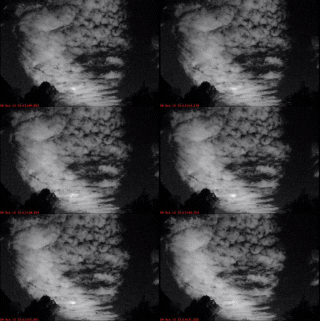
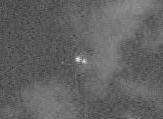 Geminids - Morning of 14 Dec 2009 from back yard of my home in Tempe, AZ. (3.5 Megabyte .wmv file.) The above frame snippet (14 Dec 09 00:35:00.717) shows the break-up of one of the meteors into two parts. Pretty cloudy but many meteors shone through the clouds. If meteors bore you, look for the cat walking on my roof. (Near lower left corner of the frames beginning at 01:32:01.) 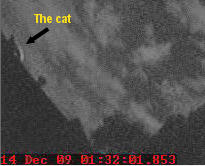 |
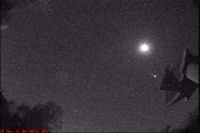 Leonids - Morning of 18 Nov 2011 from back yard of my home in Tempe,
AZ. Leonids - Morning of 18 Nov 2011 from back yard of my home in Tempe,
AZ.
(10.3 Megabyte .wmv file.) |
Leonids - Morning of 18 Nov 2011 from back yard of my home in Tempe, AZ. (10.3 Megabyte .wmv file.) Same as previous except this one slowed down to 5 frames per second. |
I think this was one day before the peak. |
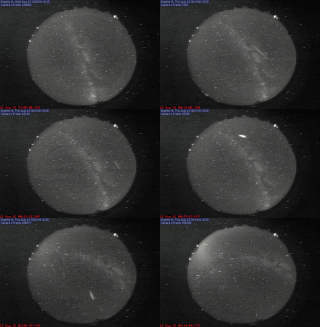
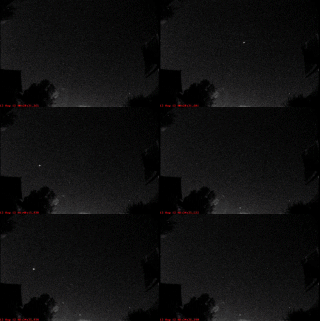 Perseid Meteors Excerpt 13 Aug 2012 From my backyard in Tempe, AZ Click on the image above to see the full size complete movie. (11 Megabytes) |
Click on the image above to see the full size complete movie. |
Click on the image above to see the full size complete movie. |
Click on the image above to see the full size complete movie. |
|
|
 Perseid Meteor Shower 11-12 Aug 2016 |
|
Geminid Meteor Shower 13-14 Dec 2020 Captured from Watec video camera in my observatory in New Mexico. This was also a really good shower! |
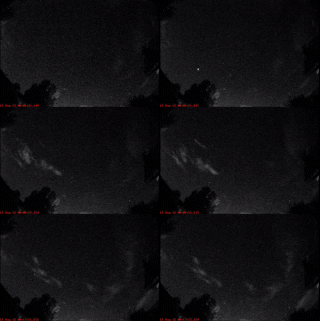
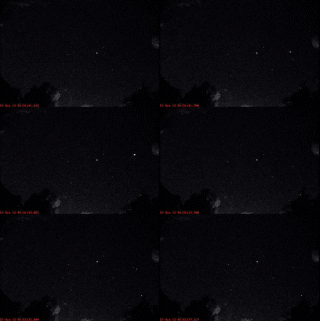

 Geminid Meteor Shower
On
the night of October 9/10, 1946, I was one month shy of being 4 years old. The Giacobinid meteor
shower put on a spectacular display that year. We were living in
Eugene, Oregon where, at the time, the skies were extremely dark.
It was also totally clear that night, unusual for Eugene in
October. It must have been mentioned on the radio? Anyway,
my father had us go outside to see the meteors. I remember that
he had me chasing about trying to catch one. My recollection is
that they were occurring at a rate of about 3 per second which would be
around 10,000 per hour. I know I didn't have to wait very long
for each one I tried to catch. It is still pretty vivid in my
mind.
The reported peak was at 3:53 UT which would have been 7:53 PM local
Eugene time. My recollection is that it was relatively early in
the evening so I assume we were observing during the peak. After
30 minutes or so the rate diminished and we went back in the house.